
Acute Pain vs Chronic Pain | What Most People Get Wrong


Pain Doesn’t Just Hurt. It Changes Who You Are.
Why the relief never holds, and what finally makes it last.
You know before you open your eyes.
There’s a moment every morning, before you’re properly awake, where you run the check. Which side did I sleep on? How bad is it today? Can I still do what I promised on Saturday? Other people wake up. You take an inventory, and the day arranges itself around the answer.
Pain that lasts long enough stops being a symptom and becomes a circumstance. It changes what you say yes to. It makes you unreliable in your own eyes. Most of the people we see have stopped describing it to friends, because after a few years there is nothing new to say.
By the time they find us, most have done the rounds. The GP, the scan, the physio, the specialist, the second opinion. A folder of results and a drawer of half-finished treatments. And somewhere in it, the sentence that closes the conversation down: everything came back normal.
Why I do this work
I was fourteen, playing softball at a level I’d worked years to reach, when I injured my back. What I remember isn’t the pain. It’s what the pain took with it: the sport first, then a fair amount of who I was. I went quiet. I went flat. At fourteen you have no language for that.
What changed it was one practitioner who understood how a body works, not just where it hurt. I know what it is to be told to live with it. And I know what it’s like to find out that isn’t the last word.
When the scan isn’t the whole story
Some people come to us with clean imaging and years of pain nobody can explain. Others come with a finding, a bulge or a tear or degeneration, that has been treated hard for years without holding. Both groups get handed the same conclusion eventually. This is something you’ll have to live with.
Scans and symptoms correlate far more loosely than most people assume. Large reviews of spinal MRI find bulges and degeneration in a substantial share of people with no pain at all, and the proportion climbs with every decade of age. A finding is useful information. It just isn’t always the reason it hurts.
The tissue nobody was looking at
Cut open a grapefruit and look at the white pith that separates every segment and holds the fruit in its shape. Take it away, and you don’t have a grapefruit. You have juice.
You have the same webbing. It’s called fascia: a continuous sheet of connective tissue wrapping every muscle, organ, nerve and vessel, running unbroken from your feet to your skull. For most of medical history, it was simply what surgeons cut through on the way to something more interesting.
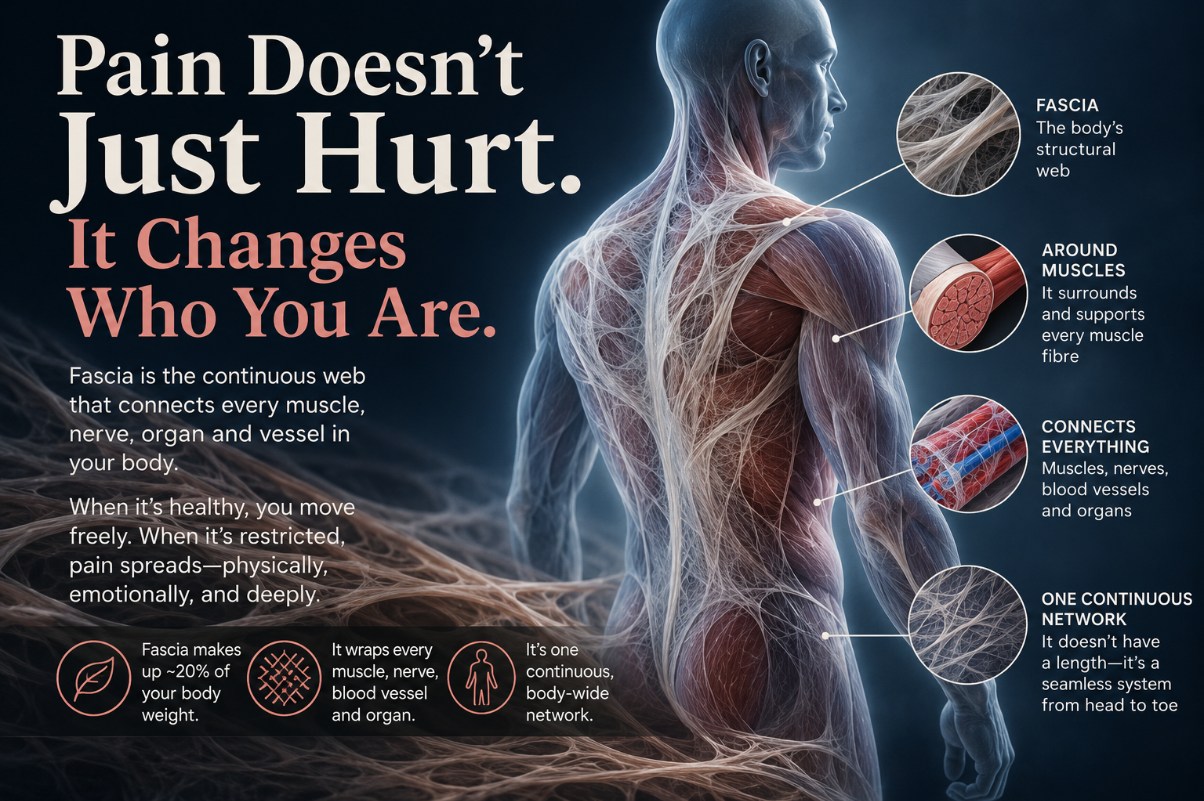
That was an oversight. Fascia is densely supplied with sensory nerve endings, including the ones that report pain. Healthy fascia is wet, and its layers glide over one another like silk. Injure it, sit on it for fifteen years, hold it tight through a decade of stress, and it dries and thickens. Silk turning to felt. And every nerve ending in it keeps reporting.
Now pull hard on one corner of a shirt hem. The pucker doesn’t stay at the hem. It travels across the front, up through the shoulder, dragging the collar crooked. Nobody would blame the collar. Fascia is one continuous garment, which is why a restricted hip changes how your ribs expand and how freely your neck turns, and why treating only the sore spot buys a few good days and nothing more. You’ve ironed the collar. The hem is still bunched.
What’s actually stuck
In 2018, researchers described fluid-filled spaces running through connective tissue all over the body and called it the interstitium. Think of it as the drainage field before the drain: waste and inflammatory chemicals have to move through it before the lymphatic system can carry them off. When fascia thickens and compresses that space, drainage slows.
Lymph is uniquely vulnerable to that, because it has no central pump. Blood has a heart. Lymph has only the contraction of its own vessels, helped along by movement and breathing. It’s a canal system rather than a river. It moves when the locks are worked.
A creek that keeps moving runs clear. Slow it down and silt settles, the bed narrows, less water gets through, and more silt settles. That’s the loop. Inflammation slows drainage, poor drainage concentrates inflammatory chemicals in the tissue, and those chemicals sensitise the nerve endings living in the fascia. The pain starts feeding itself. Which is why it doesn’t resolve on its own, and why rest alone so rarely fixes it.
Ayurveda described this thousands of years ago
Rasa dhatu, the first of the seven tissues, corresponds closely to plasma, lymph and interstitial fluid, and its free movement through the body’s channels, the srotas, was treated as a precondition of health. Obstruct those channels, and you get ama: stagnant residue that lodges in the tissues and produces exactly the heaviness, stiffness and dull persistent ache the texts describe.
Silt in the creek. The same observation, five thousand years earlier, made without a microscope. And the classical response was never rest. It was heat, oil, movement, and hands working directly into the tissue.
So what actually shifts it
Two things have to happen, and they have to happen in order. What’s lodged in the tissue has to be loosened. Then it has to leave.
Sweeping is only half the job. Pile the dust in the middle of the room and walk away, and you’ve achieved nothing. Most bodywork does the sweeping. That is precisely why the relief only lasts a few days.
Siddha paste does the loosening. A topical preparation of herbs chosen to penetrate the tissue rather than sit on the surface of it. It warms the area and softens what has hardened there, the dense adhesive quality that builds up in tissue held protectively for years. In the classical framework, this is what lifts ama out of where it has lodged.
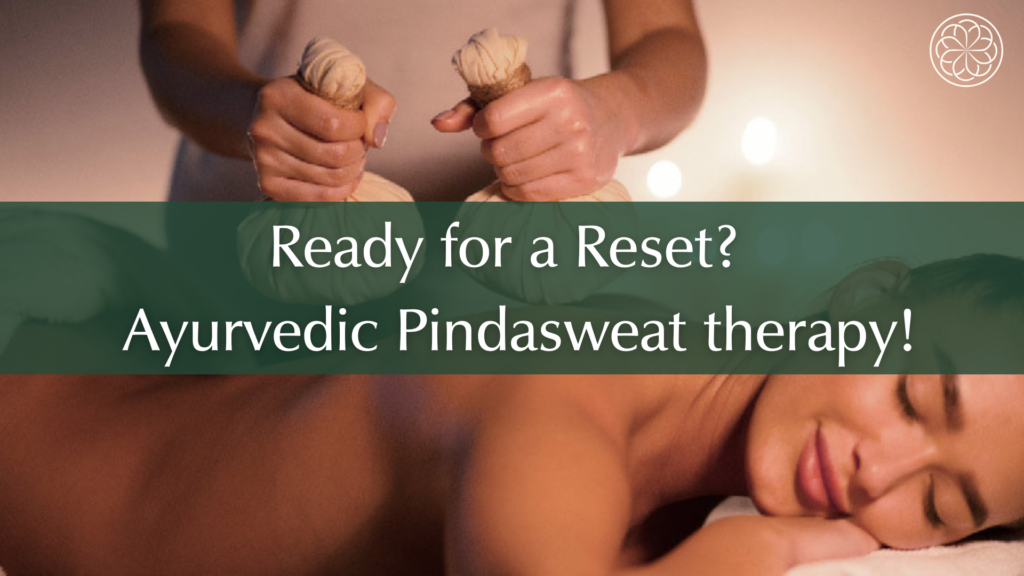
Pindasweda opens the way out. A form of swedana, or therapeutic sudation, delivered through a herbal bolus. Ours carries fifty-seven herbs, bound in cloth, warmed, then worked rhythmically over the body with sustained pressure. The heat carries the herbs in and opens the srotas, the channels fluid has to travel through. Read against the fascia research, the mechanics line up: moist heat alters the pliability of connective tissue, and sustained rhythmic pressure is exactly the input that assists interstitial and lymphatic flow.
The 28-day detox carries it out of the house. The food protocol moves through three stages, run alongside the herbal detox medicine. Real food the whole way through, not a fast and not a shake program, and heavily plant-based to bring the inflammatory load down while the herbs do the deeper work.
We run these together rather than selling them separately. You can mobilise ama out of tissue all day long. If the body has no capacity to process and clear it, it simply settles somewhere else.
What this looks like in practice
One woman came to us after three years of managing her pain with medication and taking 3 types of pain medication with no result. After a single Ayurvedic treatment, she described her pain as roughly 80% lower, and it held.
That isn’t what happens for everybody, and you should be wary of anyone who promises you it will. But results like hers stopped surprising us a long while ago. When you treat what’s actually driving the pain rather than the signal it’s producing, the body moves faster than anyone expects. In most cases, it has been waiting for the opening.
If you’re taking prescribed pain medication, please keep taking it and keep your doctor in the loop. Any change to that is a conversation between the two of you.
Between sessions, the work is yours
- Move often, not hard. Frequent gentle movement beats one punishing session followed by six sedentary days.
- Breathe deliberately. Slow diaphragmatic breathing drives the pressure changes that assist lymphatic return. Five minutes counts.
- Break up sitting. Stand and move every 30 to 45 minutes. Stillness is what lets the creek silt up.
- Drink CCF tea, warm. Cumin, coriander and fennel, one teaspoon of each in a litre of water, boiled for ten minutes, kept in a thermos and sipped across the day. We blend it at the clinic.
If this sounds familiar
If you’re living with pain that hasn’t responded, whether nobody found a cause or the cause was found and treating it didn’t hold, come and talk to us.
Sometimes the question isn’t what’s damaged. It’s what isn’t moving.