
The Medicine Cabinet You Walk Past Every Day

What Ayurveda Says About 6 Everyday Spices and Why Digestion Comes First
Long before “food as medicine” became a wellness headline, Ayurveda, the traditional medical system of India with roots stretching back thousands of years, was built almost entirely on that premise. In Ayurvedic thinking, the kitchen and the pharmacy were never separate places. Many of the spices sitting in a home cook’s cupboard today were, and still are, prescribed with the same seriousness as a remedy.
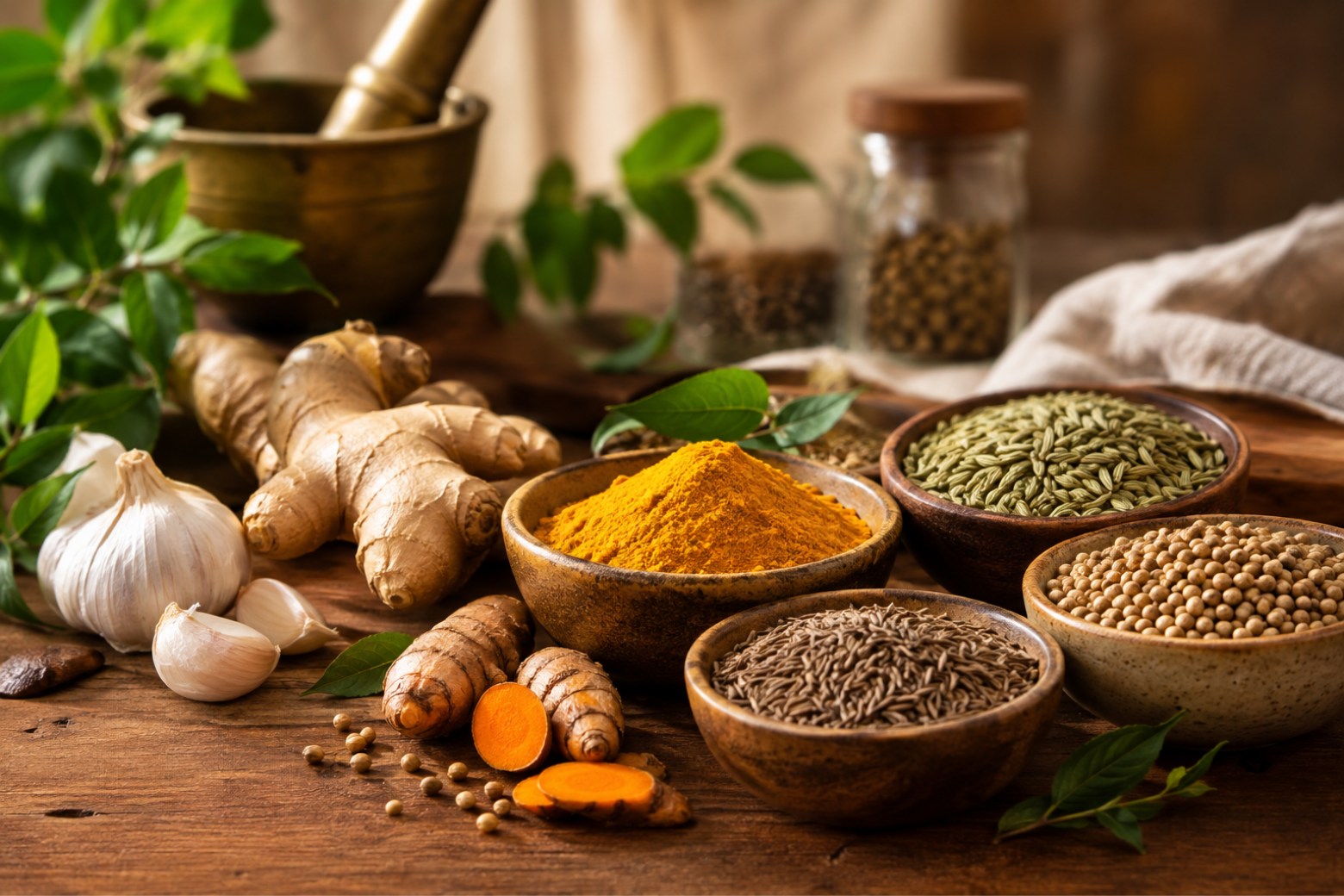
Six of the most common are garlic, ginger, cumin, coriander, fennel, and turmeric. Individually, each has a distinct role. Together, they tell a story about how Ayurveda approaches health: not through isolated “superfoods,” but through balance, digestion, and the everyday rhythm of a meal.
Digestion First, Always
To understand why these spices matter so much in Ayurveda, it helps to understand agni, digestive fire. Ayurvedic tradition treats agni as the engine behind nearly all health, the process that determines whether food becomes nourishment or becomes waste that clogs the system. Weak agni is blamed for everything from bloating to fatigue to skin issues.
This is why so many Ayurvedic spices fall into two working categories: deepana (those that stimulate digestive fire) and pachana (those that aid the actual digestive process). It’s also why spices show up not as garnish, but as functional ingredients added at specific points in cooking, or eaten before or after a meal with intention.
The Warming Trio: Garlic, Ginger, Turmeric
Garlic (Lahsun) is considered pungent, oily, and heating, and is unusual in classical texts for containing five of the six recognised tastes, everything except sour. It’s treated as a rasayana, a rejuvenative for the body’s tissues, and is traditionally associated with circulatory and respiratory health, as well as easing Vata-type stiffness in the joints. Interestingly, garlic is often left out of strict sattvic (yogic or monastic) diets precisely because it’s considered too stimulating and heating for a calm, meditative state.
Ginger (Shunthi/Ardraka) carries perhaps the boldest reputation of the group. It’s referred to in classical Ayurvedic texts as vishwabhesaj, the “universal medicine.” Pungent and heating, it’s the go-to spice for kindling digestive fire, easing nausea, and drying excess mucus in the respiratory system. Ayurveda even distinguishes between fresh ginger and dried ginger, treating the dried form as sharper and more intensely heating.
Turmeric (Haridra) is arguably the most revered of the six, used both as food and as topical medicine. It’s classified as bitter, astringent, pungent, and heating, and sits in a special category of “blood-purifying” herbs (rakta shodhana). Traditional uses span the liver, the joints, the immune system, and the skin. Turmeric pastes have long been applied externally for wounds & infection, and complexion.
The Cooling Trio: Cumin, Coriander, Fennel
Cumin (Jeera) breaks the pattern of “digestive spice equals heating spice.” It’s considered cooling and is one of the gentlest options in the Ayurvedic toolkit. It’s frequently recommended for people with sensitive digestion and has a traditional role in postpartum recovery care. It is a natural steroid for the gut.
Coriander (Dhanyaka) is prized as one of the few spices considered safe and beneficial for nearly every body type in Ayurveda. Sweet, slightly bitter, and cooling, it’s used to calm digestive heat and acidity, support the urinary system as a mild diuretic, and soothe heat-related skin irritation.
Fennel (Saunf) is the familiar after-dinner seed served in South Asian restaurants and homes, a habit rooted directly in Ayurvedic practice rather than mere custom. Sweet and cooling, it’s classified as a carminative, meaning its traditional role is reducing gas and bloating after eating. It’s also associated with supporting lactation in nursing mothers.
Balancing the Body’s Energies
Ayurveda organises the body around three doshas, Vata, Pitta, and Kapha, and each spice is understood partly through which doshas it balances or aggravates. Broadly:
-
Vata (associated with air and movement) is calmed by warming, grounding spices like ginger and garlic.
-
Pitta (associated with fire and heat) benefits most from the cooling trio, cumin, coriander, and fennel, and can be aggravated by too much garlic or turmeric.
-
Kapha (associated with earth and heaviness) responds well to the heating, stimulating qualities of ginger, garlic, and turmeric.
This is part of why Ayurveda resists blanket claims like “everyone should eat more turmeric.” The traditional approach is individualised: a spice that balances one person’s constitution might, in theory, push another’s further out of balance.
Not Just Eaten, Applied
A detail easy to miss in a diet-only framing: several of these spices, especially turmeric and garlic, are used externally as well as internally in classical practice, as pastes, oils, and poultices. This reflects a broader Ayurvedic idea that “food as medicine” isn’t limited to what’s eaten; the same ingredients can be therapeutic when applied to the skin or joints. If you saw one of our previous articles, you may remember us talking about Pinda Sweda, a traditional Ayurvedic therapy using warm herbal boluses applied to the body.
One of the key ingredients we use in these boluses is dry ginger, traditionally valued in Ayurveda for its warming properties and its ability to support circulation, ease stiffness and help bring warmth and movement back into the tissues.
The Bigger Picture
What’s notable about all six of these spices is how ordinary they are. None require a specialty shop or an exotic supply chain; they’re kitchen staples in much of the world already. Ayurveda’s contribution isn’t the discovery of the ingredients themselves, but a detailed, centuries-old framework for when, why, and for whom to use them.
Whether or not one subscribes to the dosha system, the underlying instinct that digestion is central to well-being, and that the right spice at the right time can support it, is a thread connecting traditional systems around the world, and part of why “food as medicine” keeps resurfacing as a modern headline for something ancient.