
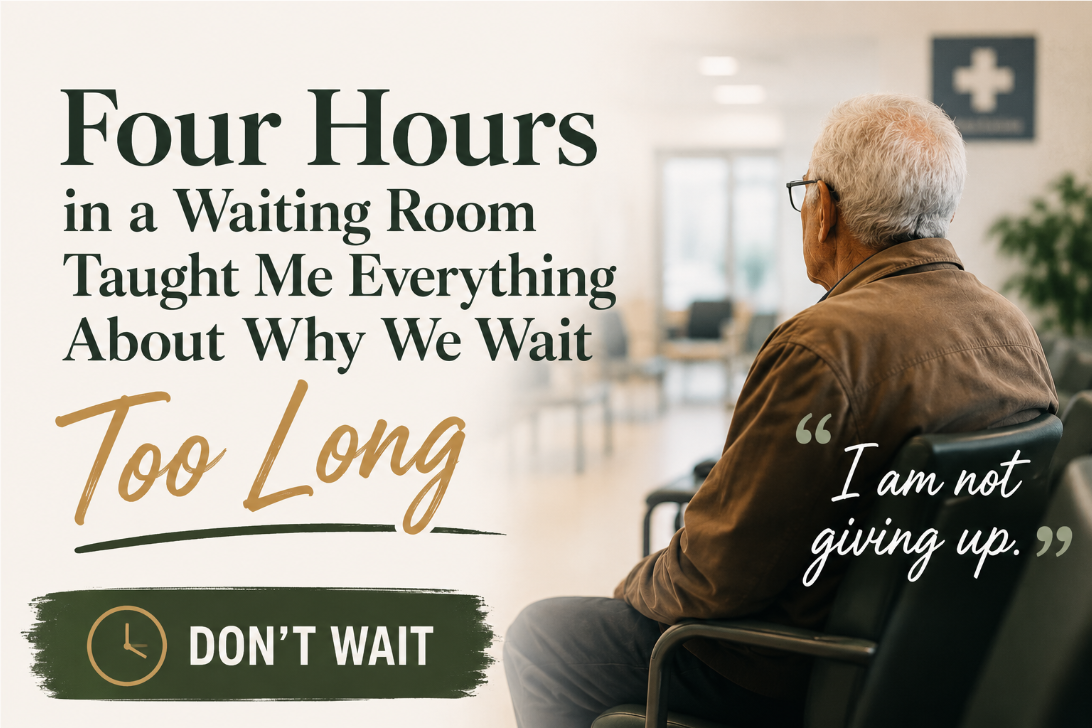
Four Hours in a Waiting Room Taught Me Everything About Why We Wait Too Long

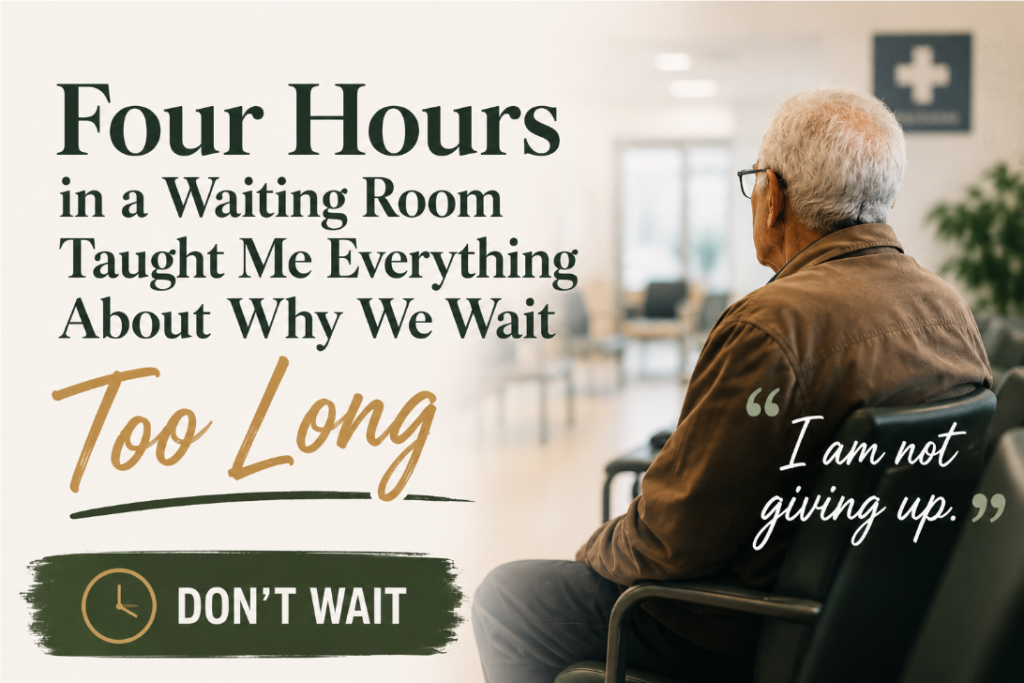
This week, I took my 85-year-old father-in-law to the hospital.
He had travelled the better part of a day to get there, all the way from Hervey Bay. Our appointment was for 9:45. We arrived at 9:30, early, organised, and ready. My team had cleared my whole morning of consults so I could be there and be fully present for him.
The doctor walked in at 1:00 in the afternoon.
Four hours. No one came to tell us what was happening. No one gave us an update, an apology, or even the courtesy of an explanation for why an 85-year-old man was left sitting under those fluorescent lights, tired from a day of travel. Meanwhile, my team had already started calling my clients, because it was clear I wouldn’t make it back in time.
And when someone finally came, it wasn’t the specialist who was meant to see him. There weren’t enough doctors, so they sent a junior in his place. That part I hold no judgment over. He was doing his best with what he’d been handed.
What I do hold something over is what was said.
“We’ve looked through your information, and we’re not sure whether we can help you. We’re having trouble collating everything between the private and public systems.”
And then this: that he should be happy he’s well and has come through such an ordeal. That he shouldn’t worry that he can’t speak properly, or that he drools, as though an 85-year-old man doesn’t still want to live a full, capable life.
My father-in-law looked at me and said, “I am not giving up. Not with this spirit.”
That was the outcome of the day.
And here’s the thing that sat with me the whole drive home: that conversation could have been a phone call. The day before. Any time before an elderly man spent his energy travelling and waiting four hours to be told, “We’re not sure.”
Let me be clear about what I’m not saying
I am not anti-hospital. Far from it.
Our hospitals and our doctors are extraordinary at what they were built to do. If you’re in an accident, if you need surgery, if there’s an emergency and every second counts, there is nowhere I’d rather you be. That system saves lives every single day, and I am grateful for it.
But that is acute care. Emergencies. Trauma. Things that happen suddenly.
Where the system struggles, where I watched it struggle this week, is with the slow things. The chronic things. The conditions that build quietly over the years. There often isn’t the time to take a proper case history. There often isn’t one overarching doctor looking across everything: which specialist is treating what, which medication each one has prescribed, and whether those drugs even work safely together. Everyone sees their piece. Very few people see the whole person.
I drove home discouraged, and not only because of what happened to my father-in-law. It was the sheer number of people there. The struggle just to find a park. The whole overwhelming weight of it. A sobering reminder of where we all end up if we wait too long.
Because here’s what I know, and what I see every week: chronic conditions follow a pattern. We can often see where something is heading long before it becomes a crisis. But most people won’t treat it while it’s still a small problem. They wait until they’re in the hospital.
And I understand why. It’s almost always the same reasons. I’m swamped with work. I don’t have the time. I don’t want to change what I’m doing. I don’t have the money.
But here’s the hard truth: if you leave it until later, the cost is so much greater. Doctor’s appointments. Hospital visits. Specialist bills. Medication. Surgery. And the highest cost of all, your ability to do the things you actually want to do with your life. That is the real value being spent.
This is exactly the gap we work in
The core of what we do, in functional, integrative, and Ayurvedic medicine, is the opposite of that day.
We work to keep people out of that waiting room in the first place. We take the time. We look at the whole picture. We help people build the confidence to actually care for their own bodies: to read their own symptoms, understand what those symptoms are asking for, and change them before they become the thing that lands you under those lights.
But I have to be honest with you, because this is a wake-up call, not a comfort blanket.
Over the last six months in the clinic, I’ve watched something happen again and again. Someone comes in. We find the issue. We give them a clear path, and it involves changing some habits. And they say:
“Oh, that’s too hard. I’ll just let it go and see how it goes.”
They say it because they’re not sick yet. The pain isn’t bad enough yet to want to be better badly enough to do the work.
Here is what I need you to understand: that window doesn’t stay open.
By 60, by 70, by 80, the body has already done its degenerating. Regeneration at that point isn’t impossible, but it is so much harder, and so much slower, than prevention ever was. The easiest time to protect your health is years before you think you need to.
So this is my ask
Don’t wait for the four-hour waiting room to be the moment you start taking your health seriously.
Invest the time now. Learn how your body works. Make the small change while it’s still small. The determination it takes today is a fraction of what it will cost you later.
Because many of us tell ourselves we’ll never end up in that hospital chair.
This week reminded me: sometimes we don’t get to choose.
But let me tell you how the very next day went
Remember the client I had to reschedule, the one my team called, so we could move her appointment because of all of this?
She was so gracious about it. Grateful, even, that we’d called and given her the chance to rearrange rather than just leaving her waiting. And the day after the hospital, I saw her.
We sat down and went through everything: her pathology, her stool sample, her urine results. Piece by piece, the picture of what was happening in her body started to make real sense. We’d already started her on some herbs, some changes to her diet, a home protocol, and a medicated tea.
She’d come to me with a laundry list, over twenty different symptoms, the kind of scattered, seemingly unrelated complaints that get you passed from specialist to specialist, each one treating their own little corner and none of them seeing the whole.
Read her starting point slowly. For five years, this was her daily reality. Here are just a few of them:
-
Tired all the time, low energy that no amount of rest seemed to fix
-
Sharp sinus headaches, on top of a lifelong history of migraines
-
Broken sleep, falling asleep only to jolt awake at 2 or 3 am, then dragging through the day
-
Bloating that never really settled
-
Feeling low. Flat. Depressed.
-
Anxiety humming in the background
-
Brain fog, that frustrating sense of not being as sharp as you know you are
-
Heavy, aching legs and painful feet at the end of every working day
-
Fluid retention and poor circulation
-
Bouts of vertigo and dizziness
-
Hot flushes and menopausal symptoms
-
Nagging pain: plantar fascia, a niggling shoulder, bursitis in the hip
Does any of that sound familiar? Because here’s what I want you to notice: not one of those is dramatic enough on its own to send you to the hospital. You push through. You blame your age, your job, your busy life. You tell yourself it’s normal.
Then we went to work. And as we went back through that list together, one by one, there had been a significant shift in almost every single one. The energy came back. The mood lifted, “not depressed at all” now. The dizziness: gone. The brain fog cleared to sharp. The heavy legs, the hip, the aches: much, much better. Sleep, steadier.
That tells you something crucial: we weren’t chasing twenty separate problems. We were treating the one root cause sitting underneath all of them, chronic inflammation.
You can’t see chronic inflammation. There’s no obvious lump, no dramatic scan, no single number that screams at you. It sits deep and quiet, doing its work over the years, showing up as a dozen “small” things you learn to live with. But make no mistake, it is the fire smouldering underneath so much of what eventually lands people in the hospital wards.
Partway through her consult, she looked at me and said:
“Jo, with what you and your team have given me and the treatments I’ve been having, this is the best investment I have ever made in my entire life. I haven’t felt this good in years.”
Sit with the contrast for a moment.
One person spent four hours to be told: “We’re not sure we can help you.” The other took control of her health, made it a genuine priority, invested her time and energy, and is now living in a body that feels better than it has in years.
That is the difference. And it’s not luck. It’s a choice, made early enough to matter.
Because this was never about a single appointment, what you implement is who you get to be in ten years, in twenty, in thirty, in forty. Your body isn’t a machine you drop off to be fixed. It’s a living organism, and it needs support, consistency, and someone paying attention to the whole of it.
That shift in how you see it is where every real change begins.
 Tip of the Week
Before anything else tomorrow morning, before the coffee, before the rush, drink a glass of warm (not hot) water. If you have it on hand, add a thin slice of fresh ginger or a squeeze of lemon.
It’s a small, ancient habit that gently wakes up your digestion, supports your body’s natural overnight clearing, and sets a calmer tone for the whole day. One glass. That’s the entire ask.
Do it every morning this week and notice how you feel by the weekend. Small change, made while it’s still small.
With care, Jo